

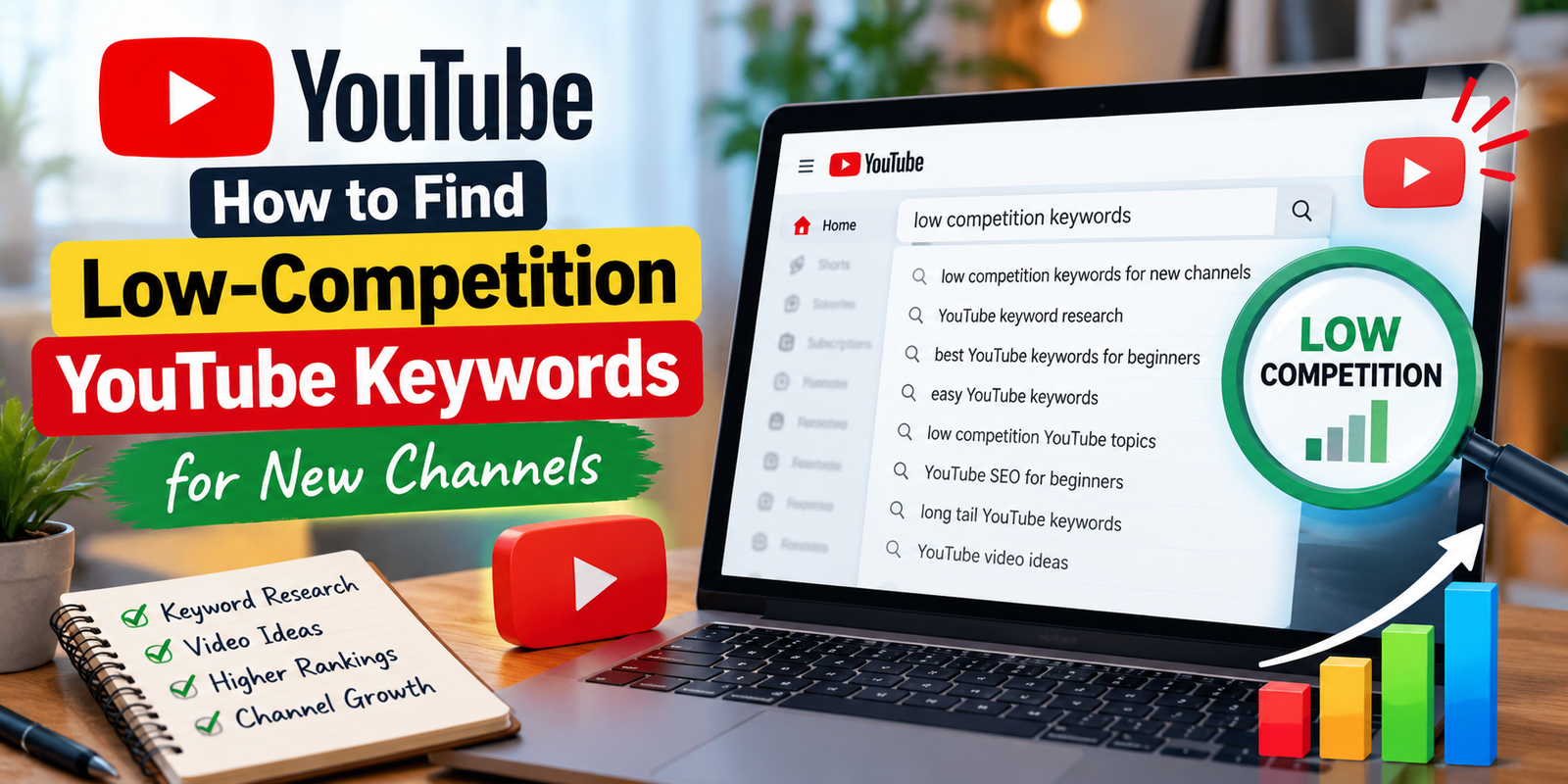
Low-Competition YouTube Keywords, Starting a YouTube channel can be challenging, especially when established creators already dominate search results. New channels often struggle to get views because their videos compete with channels that have thousands or millions of subscribers. One effective way to improve visibility is to target low-competition YouTube keywords that match what viewers are searching for.
Finding the right keywords through effective YouTube keyword research helps creators identify topics with realistic ranking opportunities. Instead of targeting broad phrases such as “digital marketing,” “fitness,” or “cooking,” new creators can focus on specific search terms that address a particular audience need. These targeted keywords can attract relevant viewers, improve discoverability, and help a channel build an engaged audience over time.
In this guide, you will learn how to find low-competition YouTube keywords for new channels, research search intent, analyze competing videos, and use keyword research techniques to develop a practical YouTube SEO strategy.
1. Understand What Low-Competition YouTube Keywords Are
Low-competition YouTube keywords are search phrases for which a new or small channel may have a reasonable opportunity to appear in search results. These keywords often target specific questions, problems, interests, or audiences rather than broad topics with extensive competition.
For example, a new fitness channel may struggle to rank for “weight loss workout.” However, a more specific phrase such as “10-minute beginner workout at home without equipment” could provide a more focused opportunity.
Low competition does not automatically mean high traffic. A keyword may have few competing videos but also attract very few searches. The goal is to identify keywords that balance relevance, achievable competition, and audience demand.
Consider these examples:
- Broad keyword: YouTube SEO
- More specific keyword: YouTube SEO for beginners
- Long-tail keyword: How to optimize YouTube videos for a new channel
The more specific phrases can help creators address a clearly defined audience need. However, actual competition and search demand should always be evaluated before selecting a target keyword.
2. Use YouTube Search Autocomplete
YouTube’s search autocomplete feature is one of the easiest ways to discover keyword ideas without purchasing specialized software. When users enter a phrase into the search bar, YouTube suggests related searches based on various signals.
These suggestions can reveal common questions and specific topics that viewers may want to explore.
How to Find Keywords Using Autocomplete
- Open YouTube in your browser.
- Enter a broad keyword related to your channel.
- Review the suggested search phrases.
- Add words such as “how to,” “for beginners,” “without equipment,” “step by step,” or “on a budget.”
- Record relevant suggestions in a keyword spreadsheet.
- Search promising phrases individually to examine the existing videos.
For example, a channel about video editing could explore phrases such as “video editing for beginners,” “video editing on a low-end PC,” and “how to edit YouTube videos on a laptop.”
Do not select a keyword simply because YouTube suggests it. Check whether the phrase matches your audience, supports a useful video idea, and has a realistic competitive landscape.
3. Research Long-Tail YouTube Keywords
Long-tail keywords are specific search phrases that usually contain several words. They can be valuable for new channels because they help creators target viewers with a clear purpose.
A broad keyword such as “SEO” covers an enormous subject. A long-tail keyword such as “how to find low-competition keywords for a new website” identifies a more precise need.
Long-tail keywords can be particularly useful in educational, technology, gaming, cooking, travel, and product tutorial niches.
Examples of Long-Tail Keywords
- How to start a YouTube channel with no subscribers
- Best free video editing software for beginners
- How to record YouTube videos using a smartphone
- Easy vegetarian dinner recipes for beginners
- YouTube thumbnail design tips for small channels
- How to improve video quality without expensive equipment
These phrases can help you create focused videos rather than generic content. They also make it easier to communicate a video’s specific benefit in its title and introduction.
However, long-tail keywords are not automatically low-competition keywords. Always examine the search results and compare competing videos before deciding which phrase to target.
4. Analyze Your YouTube Competitors
Competitor research helps you understand which topics are already covered and where useful content opportunities may exist. Instead of copying successful creators, look for specific questions they have not answered adequately.
Search for a potential keyword and examine the first page of results. Pay attention to the relevance of the videos, their publication dates, their presentation quality, and the questions viewers ask in the comments.
Look for opportunities such as:
- Older videos with outdated information.
- Videos that do not fully answer the search query.
- Search results that cover the topic only briefly.
- Common viewer questions that remain unanswered.
- Specific subtopics that receive attention but lack dedicated videos.
For example, a broad search for “YouTube keyword research” may show many established creators. A more focused search for “YouTube keyword research using free tools” could reveal an opportunity to create a practical tutorial.
Do not assume that low-view videos are easy to outrank or that high-view videos indicate impossible competition. Views depend on several factors, including audience interest, video age, recommendations, and external promotion. Evaluate the quality and relevance of the results as a whole.
5. Use Free and Paid Keyword Research Tools
Keyword research tools can help you expand your ideas, compare related phrases, and organize potential video topics. Some tools offer free features, while others provide more detailed data through paid plans.
Useful options include:
- YouTube Studio: Review your channel’s analytics and available research insights to understand how viewers discover your videos.
- Google Trends: Compare interest in related topics and explore how interest changes over time. You can also examine YouTube Search as a search type where available.
- vidIQ: Explore YouTube keyword ideas and competition-related indicators using its available features.
- TubeBuddy: Research keywords and examine optimization opportunities through its available tools.
- Google Search: Find related questions, tutorial ideas, and alternative ways people describe a topic.
For official guidance on improving your videos’ discoverability, consult YouTube’s Creator Academy. It provides educational resources for creators who want to improve their content and channel performance.
Remember that keyword scores and estimated search volumes are not guarantees of ranking success. Different tools may use different data sources and estimation methods. Use their results to guide your research rather than treating any single score as definitive.
6. Evaluate Search Intent Before Choosing a Keyword
Search intent refers to the reason someone enters a particular phrase into the YouTube search bar. Understanding this intent helps you create content that satisfies the viewer’s expectations.
For example, someone searching “best microphones for YouTube beginners” probably wants product comparisons or recommendations. Someone searching “how to connect a microphone to a laptop” expects a step-by-step tutorial.
Common YouTube search intents include:
- Informational: Viewers want to learn something.
- Tutorial-based: Viewers need instructions for completing a task.
- Comparative: Viewers want to compare products, tools, or methods.
- Entertainment-focused: Viewers want to watch engaging or amusing content.
- Problem-solving: Viewers need help fixing a specific issue.
Before choosing a keyword, review the videos already ranking for it. If most results are tutorials, creating a general opinion video may not satisfy the same intent. Matching the format and depth of content to the search query can improve its relevance to viewers.
7. Focus on Questions and Problems in Your Niche
A strong keyword strategy begins with understanding your audience. New creators should identify the questions, frustrations, and goals that matter most to their intended viewers.
Explore YouTube comments, relevant online communities, discussion forums, and customer reviews to discover recurring questions. These sources can reveal content opportunities that broad keyword lists may overlook.
For example, a gaming channel could target “how to reduce lag in Minecraft on a low-end PC.” A cooking channel could explore “how to make crispy potatoes without an oven.” A technology channel could create a tutorial on “how to free up storage on an Android phone without deleting photos.”
Each topic addresses a specific problem. This approach helps you develop useful videos for a defined audience while building a consistent content strategy around related keywords.
Avoid choosing topics solely because they appear popular. The strongest opportunities are those that align with your expertise, your audience’s needs, and your ability to produce a genuinely helpful video.
8. Check Competition and Search Demand Together
Before finalizing a keyword, evaluate both its potential demand and the strength of competing videos. A useful keyword is not necessarily the one with the highest estimated search volume. It is the one that offers a realistic opportunity to reach the right audience.
Create a simple scoring system to compare your keyword ideas.
| Evaluation factor | What to check |
|---|---|
| Search demand | Is there evidence that people search for the topic? |
| Competition | How relevant and comprehensive are the existing videos? |
| Audience relevance | Does the keyword match your channel’s target viewers? |
| Search intent | Can your planned video satisfy the viewer’s expectations? |
| Content opportunity | Can you provide a clearer, more useful, or more current answer? |
Rate each factor on a scale of 1 to 5. For competition, a higher score should mean that the competitive landscape appears more achievable, not more difficult.
For example, a specific tutorial with relevant search suggestions and several incomplete competing videos may deserve further investigation. A broad keyword dominated by highly relevant, comprehensive videos may be less suitable for an early-stage channel.
Treat this scoring system as a practical prioritization method rather than a formal prediction of YouTube rankings.
9. Optimize Your Video Title, Description, and Content
Once you identify a suitable keyword, use it naturally throughout the video’s metadata and content. Keyword placement can help communicate the subject of a video, but it does not guarantee higher rankings.
Follow these YouTube SEO practices:
Write a clear title. Include the primary keyword when it fits naturally. For example, “How to Find Low-Competition YouTube Keywords for Beginners” clearly describes the video’s subject.
Create a useful description. Explain what viewers will learn, summarize the key steps, and include relevant phrases where appropriate. Avoid repeating the same keyword unnecessarily.
Deliver on the title’s promise. Introduce the topic clearly and provide the information viewers came to find. A keyword-optimized title cannot compensate for an unhelpful video.
Use relevant thumbnail design. Create an easy-to-understand thumbnail that accurately represents the content. Strong visual communication can encourage interested viewers to click.
Organize longer videos. Use chapters when appropriate so viewers can navigate the main sections more easily.
Review performance. Monitor impressions, click-through rate, watch time, audience retention, and traffic sources in YouTube Studio. Interpret these metrics together rather than relying on a single number.
YouTube considers multiple signals when recommending and ranking videos. Keyword optimization should support a broader strategy focused on relevance, viewer satisfaction, and useful content.
10. Build a Keyword Strategy for Your First 30 Videos
New channels benefit from a structured publishing plan. Instead of targeting unrelated topics, organize your first videos around a small number of closely related themes.
Start by choosing three to five core topics for your niche. Generate several long-tail keyword ideas for each topic, investigate their competition, and prioritize the phrases that best match your audience.
For example, a channel about YouTube growth could organize its early content into these groups:
- Keyword research: Finding low-competition keywords, using autocomplete, and researching long-tail phrases.
- Video optimization: Writing titles, improving descriptions, and designing thumbnails.
- Channel growth: Planning content, understanding analytics, and improving audience retention.
- Creator tools: Comparing free editing software, thumbnail tools, and keyword research platforms.
Publish videos that address distinct questions within these groups. Link related videos through playlists and relevant end screens to help viewers discover more of your content.
After publishing, review the results and identify topics that attract relevant viewers. Use those findings to refine future keyword choices. This process turns keyword research into an ongoing improvement cycle rather than a one-time task.
Read More: YouTube AI Tools in 2026: How Creators Can Automate Video Workflows
Conclusion
Finding low-competition YouTube keywords for new channels requires research, audience understanding, and consistent testing. YouTube autocomplete, long-tail keyword research, competitor analysis, free research tools, and search-intent evaluation can help you identify promising topics.
The most effective strategy is to focus on specific viewer needs and create videos that answer those needs better than the available alternatives. Evaluate search demand alongside competition, optimize your metadata naturally, and use YouTube Studio analytics to learn from each upload.
You do not need to compete for every popular keyword to grow a channel. By targeting relevant opportunities, publishing useful content, and improving your approach over time, you can build a stronger foundation for sustainable YouTube growth.